Forget the backyard amateurism and the lighter fluid shortcuts. We are discussing the structural engineering of flavor; the precise moment where cellulose, hemicellulose, and lignin decompose into a gaseous symphony. When you commit to Smoked Hickory Ribs, you are not just cooking; you are managing a complex atmospheric exchange. The goal is the deposition of phenolic compounds onto a protein matrix. Hickory is the heavyweight champion of this arena. It offers a pungent, almost bacon-like profile that demands respect and a disciplined firebox. We are looking for that elusive mahogany lacquer, a surface tension that holds against the bite but yields to the tooth. This is about the physics of the "smoke ring," a nitrogen dioxide reaction that creates a pink ring of honor beneath the surface. If your ribs look like boiled cafeteria gray, you have failed the infrastructure audit. We are here to ensure your bark is crystalline, your fat is fully rendered, and your smoke profile is clean, thin, and blue. Let us calibrate the equipment and synchronize the variables.
THE DATA MATRIX
| Metric | Specification |
|---|---|
| Prep Time | 45 Minutes |
| Execution Time | 6 Hours |
| Yield | 4 Full Racks |
| Complexity | 7/10 |
| Estimated Cost per Serving | $8.50 USD |
THE GATHERS
Ingredient Protocol:
- 4 Racks (approx. 4.5kg / 10 lbs) St. Louis Style Pork Ribs
- 120g / 0.5 cup Yellow Mustard (as a binder)
- 150g / 0.75 cup Coarse Kosher Salt
- 100g / 0.6 cup Coarse Black Pepper (16-mesh)
- 50g / 0.25 cup Granulated Garlic
- 30g / 2 tbsp Smoked Paprika
- 250ml / 1 cup Apple Cider Vinegar (for spritzing)
- 120ml / 0.5 cup Filtered Water
- 250g / 1 cup Unsalted Butter (for wrapping)
- 200g / 1 cup Dark Brown Sugar
Section A: Ingredient Quality Audit:
If your ribs arrive with a thick, leathery silverskin on the bone side, your smoke penetration will be throttled. Use a paper towel to grip and tear that membrane away; it is a non-negotiable barrier to flavor. If your black pepper is pre-ground dust from a grocery store tin, your bark will be muddy. You must use 16-mesh "cafeteria grind" pepper to create the necessary surface area for smoke particles to cling to. If the pork smells faintly of ammonia, the pH has shifted; discard it. For a technical fix on dry meat, increase your water pan volume to ensure a high-humidity environment, which slows evaporation from the surface of the ribs.
THE MASTERCLASS
Step 1: The Surface Preparation
Apply a thin, even layer of yellow mustard to the entire surface of the ribs. This is not for flavor; it is an adhesive. Use a digital scale to weigh out your dry rub components to ensure batch consistency. Dust the ribs from at least twelve inches above to ensure an even distribution of particulates.
Pro Tip: The mustard acts as a surfactant, reducing the surface tension of the meat so the rub can bond effectively. This creates a uniform "tack" that prevents the rub from washing off during the initial sweat phase.
Step 2: Thermal Equilibrium and Ignition
Fire your offset smoker using kiln-dried hickory. You are aiming for a steady 107C / 225F. Avoid "white smoke" at all costs; this indicates incomplete combustion and will deposit bitter creosote on your meat. You want "blue smoke," which is nearly invisible to the eye.
Pro Tip: Use a thermal probe to monitor the ambient temperature at the grate level, not the lid. Lid thermometers are notoriously inaccurate and can vary by as much as 25 degrees, which will compromise the collagen breakdown.
Step 3: The Smoke Absorption Phase
Place the ribs on the grate, bone side down. For the first three hours, do not open the lid. Every time you "peek," you lose heat and humidity, extending the cook time and drying out the protein. After hour three, begin spritzing with your vinegar and water solution every 45 minutes.
Pro Tip: Spritzing lowers the surface temperature via evaporative cooling, which keeps the meat in the "smoke-friendly" temperature zone longer. This allows more nitric oxide to react with the myoglobin, deepening the smoke ring.
Step 4: The Crutch and Render
Once the ribs reach an internal temperature of 74C / 165F and the bark is set, lay out heavy-duty aluminum foil. Add pads of butter and brown sugar. Lay the ribs meat-side down on the sugar/butter and wrap tightly. Return to the smoker for two hours.
Pro Tip: This is essentially a braising step. The fat in the butter helps render the remaining connective tissue into gelatin, while the foil traps steam to accelerate the tenderization process. Use a bench scraper to clean your prep surface immediately after wrapping.
Step 5: The Final Glaze and Set
Remove the ribs from the foil. They should be flexible but not falling apart. Brush on a thin layer of your preferred sauce and return to the heat for 20 minutes to "tack up."
Pro Tip: Use a saucier to warm your glaze before application. Applying cold sauce to hot ribs shocks the fat and can cause the glaze to break rather than forming a smooth, viscous coating.
Section B: Prep & Timing Fault-Lines:
The most common failure is the "stall," where the internal temperature plateaus due to evaporative cooling. Do not panic and crank the heat. Trust the process. If your timing is off and guests are arriving, you can finish the wrapped ribs in a 110C / 230F oven. The meat does not know the heat source once it is wrapped in foil; the smoke absorption phase is already complete.
THE VISUAL SPECTRUM
Section C: Thermal & Visual Troubleshooting:
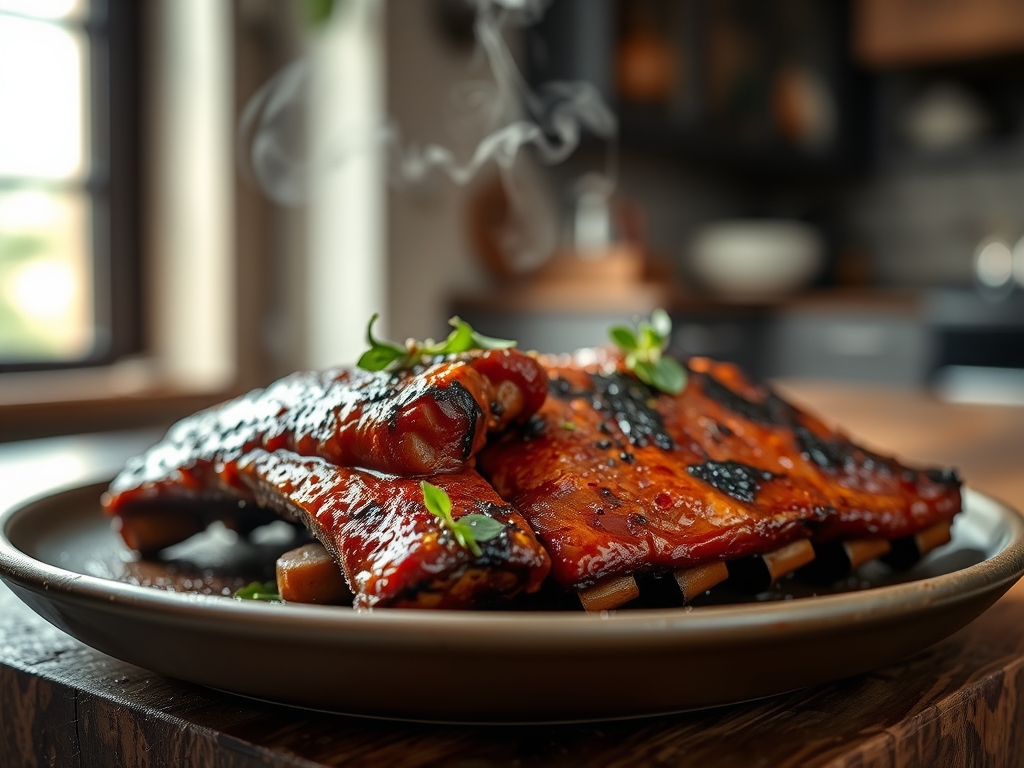
Look at the Masterclass photo. Note the "pull back" on the bones; about half an inch of bone should be exposed, signaling that the meat has contracted and the collagen has melted. If your ribs look gray and wet, your fire was too cold or your humidity was too high. If the bark is black and bitter, you had a "dirty" fire with poor airflow. A perfect rack should have a deep mahogany hue with a matte finish that turns glossy once the glaze is applied. If the sauce is sliding off, you likely have too much residual surface fat; ensure you trim the "fat cap" to a uniform 1/8 inch during prep.
THE DEEP DIVE
Macro Nutrition Profile:
A standard serving (3 ribs) contains approximately 450 calories, 32g of protein, 34g of fat, and 12g of carbohydrates (largely from the glaze and rub). The high fat content is essential for the mouthfeel and flavor transport of the hickory phenols.
Dietary Swaps:
- Vegan: Substitute pork with thick-cut "steaks" of Hen-of-the-Woods mushrooms. Use vegan butter and maple syrup in the wrap.
- Keto: Eliminate the brown sugar and use a monk-fruit-based sweetener. Ensure the mustard and rub contain no added starches.
- GF: Most dry rubs are naturally gluten-free, but verify that your liquid smoke or Worcestershire sauce (if used) does not contain barley malt.
Meal Prep & Reheating Science:
To maintain molecular structure, do not microwave. Reheat ribs by wrapping them in foil with a tablespoon of water or apple juice and placing them in a 120C / 250F oven until the internal temperature hits 65C / 150F. This prevents the proteins from tightening and becoming rubbery.
THE KITCHEN TABLE
How do I know when the ribs are actually done?
Use the "bend test." Pick up the rack with tongs at the halfway point. If the meat cracks across the top surface but does not break, the collagen has rendered perfectly.
Why is my smoke ring so thin?
The smoke ring stops forming once the meat reaches 60C / 140F. To deepen it, put your meat in the smoker while it is cold. This extends the time the myoglobin is exposed to nitrogen dioxide.
Can I use hickory chips instead of logs?
Chips burn too quickly and inconsistently for a six-hour cook. If using a charcoal grill, use hickory chunks. They provide a sustained, smoldering burn that mimics the output of a professional offset smoker.
Is it possible to over-smoke the meat?
Yes. Hickory is potent. If you leave the ribs in heavy smoke for the full six hours without wrapping, the flavor will become acrid and metallic. The foil wrap is your "kill switch" for smoke absorption.